Instagram Transcript: Paste a Reel Link, Get Every Word
An Instagram transcript is the word-for-word text of a Reel's spoken audio. There is no transcript button inside the Instagram app. You paste the Reel's link into a generator, the audio gets transcribed, and one block of plain text comes back that you can copy, translate or reuse.
- How it works: copy the Reel link → paste it into the tool below → the text comes back in seconds. No account, no app, nothing to install.
- How much text: about 15.5 characters per second of speech, measured across five Reels totalling 450.56 seconds — a 60-second Reel returns roughly 930 characters.
- What you get: no timestamps and no speaker names. What comes back clean, what you have to fix, and where transcripts break — all measured on this page.
There is no transcript button in Instagram. The words are in the audio anyway, and turning audio into text is the part that stopped being hard years ago.
Short answer: "I am really not technical enough for that" is the sentence that starts most of these conversations, and the honest reply is that there is nothing technical left to do. An Instagram transcript is the spoken audio written down as one block of plain text: you put the link in, the words come out, you copy them. No program to install, no account to create, no panel to learn and no timestamps to delete afterwards. Measured on five Reels between 36 and 96 seconds, the text came back at 106 to 322 words, and reading it took between 74 and 101 percent of the time it would have taken to watch.
Paste a public Instagram link into our free transcript tool.
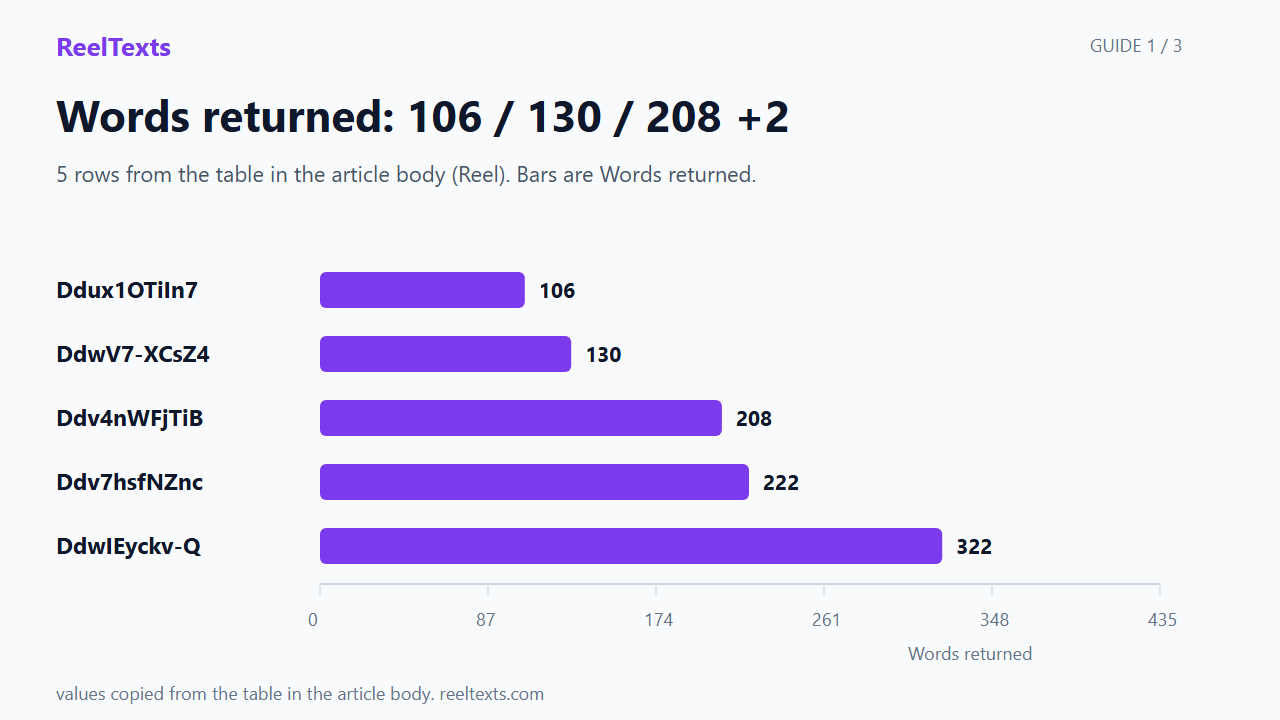
Use the free transcript toolVisual guide: Words returned: 106 / 130 / 208 +2
Three slides: 5 rows from the table in the article body (Reel). Bars are Words returned.
Watch the guide
Three slides, thirty seconds, English captions in the player. The video is silent by design; the captions carry the words.
What an Instagram transcript actually is
Got a local file instead of an Instagram link? The free MP3 to text converter on this site runs entirely in your browser — no upload, no signup, measured at 13.797 seconds for a 20-second file.
A transcript is one string of text with the spoken words in the order they were said. That is the whole format. There are no timecodes, no line breaks except the ones the recogniser inserts when it hears a sentence end, no speaker labels and no indication of what is happening on screen. If you paste it into a document, it behaves like a paragraph, not like a table.
It is produced by listening to the audio track, not by reading anything Instagram stores. This is the part people get wrong. On Instagram there is no text track to copy: the captions you see on screen are drawn into the picture as pixels, so they cannot be selected, searched or exported. There is no panel, no menu item and no export button, which is why the question "where is the transcript" has no answer inside the app. The text has to be made from the sound. The captions-versus-transcript page takes that distinction apart in detail; for this page the only consequence that matters is that a transcript is always a fresh recognition pass, never a copy.
What it is not: not a summary, not a translation, not a set of chapters, and not a search index that lives inside Instagram. Everything else people expect from a transcript is a separate job done on top of those words.
The abbreviation “ig transcript” saves seven keystrokes and changes nothing else. The URL you paste is still an instagram.com link, so the fetch step is identical; the text still returns as plain text with no format to choose; and the recognition pipeline is the same. Search engines treat the abbreviation as the same topic, so the results overlap with the full phrase. The only difference is what you typed.
Five Reels, measured end to end
The numbers below are from one run on 18 October 2026: five public Reels, downloaded one at a time, audio decoded to 16 kHz mono, recognised with a base-size English model on a single CPU thread. Length is the video duration reported with the post; words are counted on the returned string with whitespace splitting; reading time assumes 200 words a minute, which is a normal adult silent-reading pace. The shortcodes are listed so you can open each post and check the length yourself.
| Reel | Length | Words returned | Words per 10 s | Reading time | Read / watch |
|---|---|---|---|---|---|
Ddux1OTiIn7 | 0:36 | 106 | 29.3 | 0:32 | 0.88 |
DdwV7-XCsZ4 | 0:44 | 130 | 29.8 | 0:39 | 0.89 |
Ddv4nWFjTiB | 1:03 | 208 | 33.1 | 1:02 | 0.99 |
Ddv7hsfNZnc | 1:30 | 222 | 24.6 | 1:07 | 0.74 |
DdwIEyckv-Q | 1:36 | 322 | 33.6 | 1:37 | 1.01 |
| Total | 5:29 | 988 | 30.1 | 4:56 | 0.90 |
Measured with the local recognition pipeline used by this site: no retries and no edits to the output. The durations are the ones the posts report, not estimates from file size.
A separate test of seven Reels returned 6,992 characters from five clips across 450.56 seconds. The other two returned almost no text; see the per-Reel character results.
The transcript does not save you time. It saves you re-watching.
Look at the last column. Five Reels, five minutes and twenty-nine seconds of video, four minutes and fifty-six seconds of reading, a total of 0.90. In plain terms: reading the transcript of a Reel takes roughly as long as watching it. If your reason for wanting a transcript is "so I do not have to sit through it", the numbers say you will sit through it anyway, just with your eyes.
That is not a defect of the tool, it is arithmetic. Speech runs at roughly 150 to 200 words a minute; silent reading runs at roughly 200 to 250. The two speeds are close, so the text is never going to be a fraction of the runtime unless the speaker is extremely slow or extremely repetitive. Anyone promising that a transcript turns a two-minute clip into ten seconds of reading is describing a summary, not a transcript.
What the text does buy is different, and worth being precise about, because it is the actual reason to want one:
- Search. You can find the one sentence you remember without scrubbing a timeline. On a 96-second clip that returned 322 words, finding a phrase is instant; finding the same moment by ear means listening again.
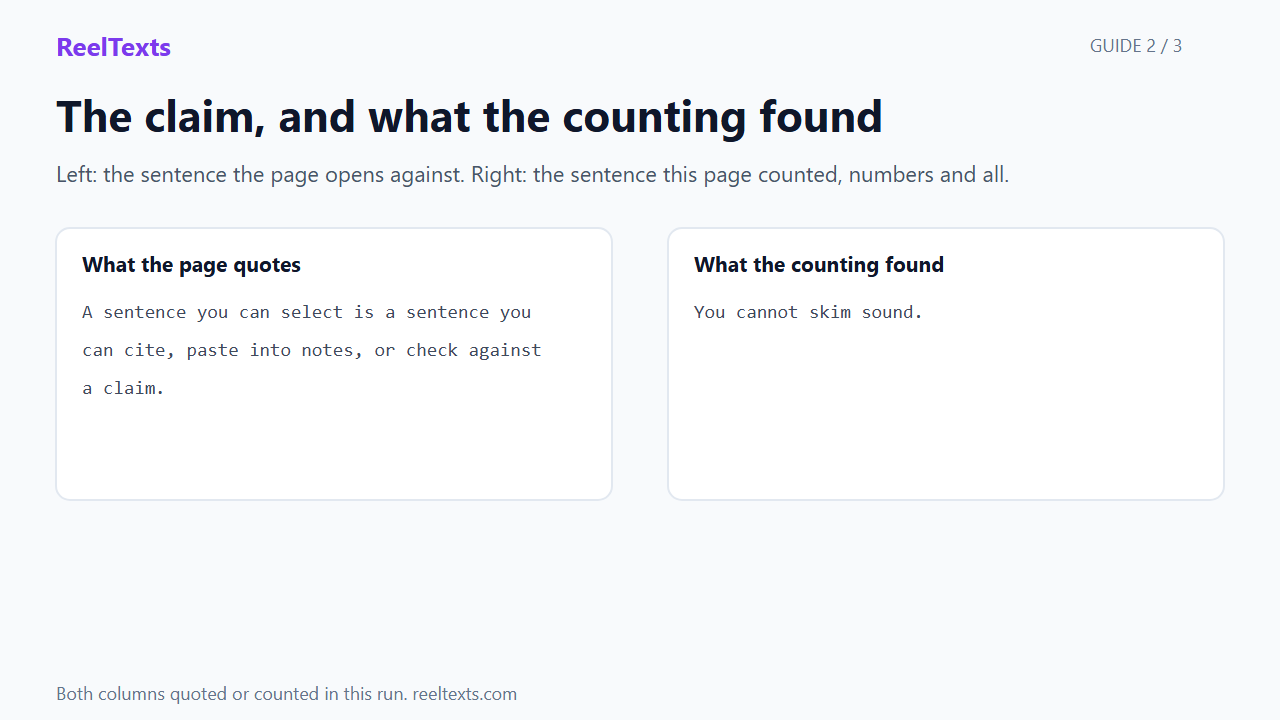
- Quotation. A sentence you can select is a sentence you can cite, paste into notes, or check against a claim. Audio cannot be quoted without re-listening and typing.
- Skipping at paragraph speed. You cannot skim sound. You can skim text, which is how a four-minute read becomes thirty seconds of scanning when you only need one part of it.
- Reuse. The same words become a caption, a blog paragraph or show notes without a second pass through the audio.
So the honest pitch is not "read it faster". It is "stop re-listening to find things". That framing also tells you when a transcript is not worth the trouble: if you only ever watch a clip once, start to finish, the text adds little.
How much text a Reel will produce, before you paste it
Across the five clips the output density ran from 24.6 to 33.6 words per ten seconds of video, averaging 30.1. That band is wide enough to be useful and narrow enough to plan with. Multiply by duration and you get the size of the text you are about to receive.
| Clip length | At 25 words / 10 s | At 34 words / 10 s | Reading time at 200 wpm |
|---|---|---|---|
| 30 seconds | 75 words | 102 words | 23 to 31 seconds |
| 60 seconds | 150 words | 204 words | 45 to 61 seconds |
| 90 seconds | 225 words | 306 words | 1:08 to 1:32 |
| 3 minutes | 450 words | 612 words | 2:15 to 3:04 |
| 5 minutes | 750 words | 1,020 words | 3:45 to 5:06 |
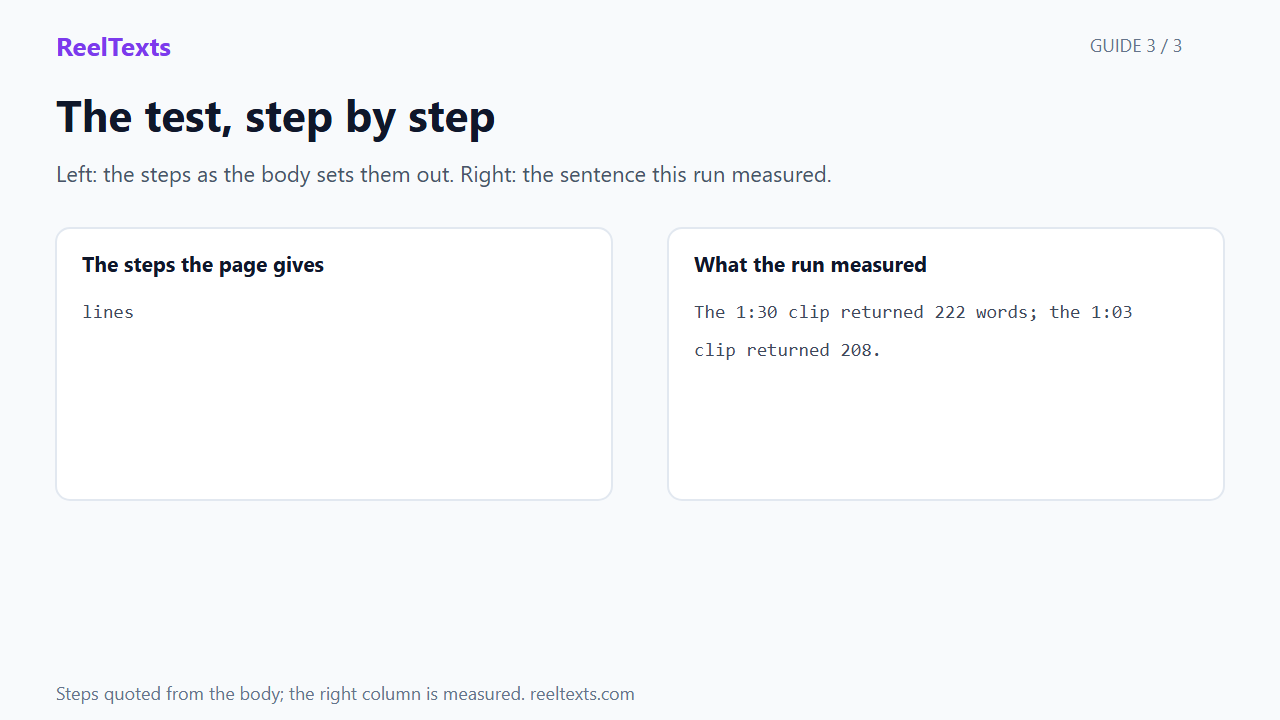
Duration is a weak predictor on its own, and one pair in the sample shows why. The 1:30 clip returned 222 words; the 1:03 clip returned 208. Twenty-seven extra seconds of video bought fourteen extra words, because the longer clip had more silence and slower delivery. Density, not length, decides the output size. A talking-head clip with continuous speech will out-produce a longer clip with pauses, music beds and on-screen text.
The same arithmetic works in reverse for planning. If you need about 300 words for a blog paragraph, you are looking for a Reel of roughly a minute and a half at average density, or a tighter one of about 90 seconds if the speaker talks fast. If you need 600 words, expect a three-minute clip and a read that takes as long as watching it twice.
What comes back clean, and what you have to fix
Three things survived the recognition step well enough to use without editing. Punctuation was present in all five outputs, including sentence-ending marks: six in the shortest clip, twenty-seven in the 1:30 one. Order was correct throughout, with no blocks out of sequence. Ordinary vocabulary was clean; nothing in the five transcripts needed a second opinion except proper nouns and one compound word.
Two things need a check before you publish.
Filler words are inconsistent. Two of the five outputs kept them: six instances in 208 words (2.9 per hundred) and four in 222 words (1.8 per hundred). The other three had none at all. So you cannot assume a cleanup pass is needed on every clip, and you cannot assume it is not: scan for "um", "uh" and "you know" before you paste the text anywhere public.
Names, numbers and compounds are where the errors live. The 1:36 clip returned "nor Easter" for "nor'easter": the apostrophe is gone and both halves are capitalised as though it were a person. Nothing else in that transcript was wrong in a way a reader would notice, which is exactly why this kind of error is dangerous - it looks like a name, so it survives proofreading. Read every capitalised word and every figure against the audio before the text goes anywhere.
Line breaks are the other thing to expect. Most outputs arrive as one continuous block. If you need a line per sentence, that is your formatting step, not the transcript's job. The error checklist covers the full set of failure modes if the text looks wrong rather than merely unformatted.
What an Instagram transcript scores, word by word
The recogniser decodes in beams: it proposes several readings of the next word, scores them and keeps one, so the chosen word carries a score to the end of the decode. Production runs the base model, int8, five beams and automatic language detection (server.py:496), so the numbers below came from the same engine the public page uses.
The public page never prints that score. It returns one string with no timestamps and no per-word fields (public/app.js:198), which is why a transcript can look confident while a third of it was a coin toss. For the measurement the same engine ran with word timestamps switched on, so each word carried its start, its end and its probability. That number is the engine's own confidence in the word it picked. It is not a measured error rate, and this measurement does not compute one.
Ten public Reels were sampled on 31 October 2026; seven had speech. The per-Reel table and language summary below use the same seven clips, totalling 243.98 seconds and 615 words.
| Clip | Seconds | Words | Mean word confidence (per Reel) | Lowest | Under 0.50 | Under 0.90 |
|---|---|---|---|---|---|---|
DcL40APKZNl | 41.24 | 35 | 0.855 | 0.221 | 3 | 16 |
De1pLVzRSqM | 26.94 | 71 | 0.943 | 0.404 | 2 | 12 |
DciJQH1NWpB | 23.34 | 30 | 0.549 | 0.169 | 16 | 28 |
DfAJcknoAzc | 42.93 | 124 | 0.654 | 0.001 | 41 | 86 |
DeyeohZJtzA | 40.89 | 148 | 0.627 | 0.033 | 47 | 122 |
DemHLtwuGyC | 25.29 | 93 | 0.686 | 0.193 | 20 | 74 |
DfHVW1WpMKk | 43.35 | 114 | 0.394 | 0.000 | 71 | 112 |
| All seven | 243.98 | 615 | 0.644 | 0.000 | 200 | 450 |
Same seven Reels, grouped by language
| Language group | Reels | Shortcodes | Words | Pooled per-word median confidence | Below 0.50 | Below 0.90 |
|---|---|---|---|---|---|---|
| English | 2 | DcL40APKZNlDe1pLVzRSqM | 106 | 0.990 | 5 | 28 |
| Hindi/Urdu (non-English) | 5 | DciJQH1NWpBDfAJcknoAzcDeyeohZJtzADemHLtwuGyCDfHVW1WpMKk | 509 | 0.606 | 195 | 422 |
| All seven | 7 | DcL40APKZNlDe1pLVzRSqMDciJQH1NWpBDfAJcknoAzcDeyeohZJtzADemHLtwuGyCDfHVW1WpMKk | 615 | 0.693 | 200 | 450 |
Each pooled per-word median is calculated from all word-level scores in that language group, not by averaging Reel medians. “Below” counts scores strictly less than the threshold.
Scores are the probability the recogniser attached to the word it chose, and they are not comparable across models.
Sorted low to high, the 615 scores give a tenth percentile of 0.186, a pooled per-word median of 0.693 and a ninetieth percentile of 0.991. Only 63 of the 615 words reached 0.99 or better, and three scored exactly 0.000. Half the transcript sits under 0.693, and the bottom of the distribution is one clip that is not English.
Two of the seven clips were English. Their 106 words had a pooled per-word median confidence of 0.990; 5 were under 0.50 and 28 were under 0.90. The five below 0.50 were into 0.221, never 0.361, real 0.404, youtuber 0.430 and a 0.489 - ordinary words in sentences that read correctly.
The other five clips were in Hindi or Urdu. Their 509 words had a pooled per-word median confidence of 0.606; 195 were under 0.50 and 422 were under 0.90. The text gave the language away before the score did: three clips contained substantial non-ASCII text, with Devanagari in one and Arabic script in two.
One clip is the extreme case: 114 words at a mean of 0.394, 71 under 0.50, a lowest score of 0.000, and a text mixing English fragments with another script.
The score ranks where to look; it does not report what is wrong. On these English clips the five lowest-scoring words were ordinary ones that read correctly, while the errors the other sample on this page turned up were in names and compounds - two different measurements, and neither replaces the other.
Three of the ten Reels produced no usable text at all: 15.02 seconds returned 1 word, 9.22 seconds returned 0, 19.11 seconds returned 0. All three played music with no speech over it, and no re-run changes that. Ten Reels in, seven usable and three empty is the hit rate here, and a blank result is not evidence that the link is broken.
Three rules follow from the numbers.
1. Do not quote from a clip whose average is under 0.60. On this set that throws out one clip of seven, whose text is unusable anyway.
2. Read twice the words under 0.90 that carry information: names, figures, prices, brands. One token scored 0.003 inside a sentence that otherwise read cleanly.
3. If the text contains characters outside ASCII, check the language before the meaning. Five of seven clips here were not English, and the tool never says so.
This site takes a public instagram.com post, Reel or IGTV link and no other platform. It does not display per-word scores and does not put one confidence number on the whole transcript: ten Reels on one afternoon is not a benchmark.
Four things that decide whether a link works at all
None of the numbers above matter if the link cannot be read, and in practice there are only four reasons that happens.
- The post is not public. Private accounts, deleted posts and story links that have expired cannot be fetched by anything that is not logged in as you. The four states and what each one looks like are on the private and deleted links page.
- There is no speech. A Reel that is only music has no words to return, and a recogniser asked to transcribe one may invent fluent text rather than return nothing. The music-only page explains how to spot that.
- It is one link at a time. This site takes a link and returns text for that link. It does not accept uploaded files, does not take a folder of clips, and does not queue a batch. If you have twenty Reels, that is twenty pastes.
- The language is not English. Nothing is rejected for language. A build that carries one language returns that language’s words over foreign audio; one with automatic detection names a language first and returns text in that script. Either way you get a transcript rather than an error, and the mixed-language page covers how to tell a real one from a substituted one.
If a link fails, the useful question is which of those four it is. Retrying a private post will never work; retrying a rate-limited fetch sometimes does. The login-wall page covers the case where the link opens a sign-in screen instead of the post.
What to do with the text once you have it
The text is the raw material, and the first decision is whether you are quoting or republishing. If you are quoting, keep the shortcode next to the paragraph so the source can be found again - the transcript itself carries no link back. If you are republishing, remember that spoken words read badly in print: sentences run long, subjects restart, and the first ten seconds are usually throat-clearing. The blog, show-notes and carousel page works through one transcript turned into three formats, with the word counts at each stage.
One habit worth keeping: paste the shortcode above the text, and note the duration. Six months from now, "222 words, 1:30, Ddv7hsfNZnc" tells you whether the quote you saved came from the clip you think it did. A transcript with no source marker is an orphan.
If you save the text instead of quoting it, the file has rules of its own: what the download writes, line by line is one screen of detail, including why the block arrives without a single line break.
Questions people ask
- Is there a transcript button somewhere in Instagram?
- No. There is no transcript panel, no export option and no text track behind the captions.
- Do I need an account, an app or a plugin?
- No. If a site asks you to install something to read a public Reel, that requirement is the site's, not Instagram's.
- Why is my transcript one long block with no paragraphs?
- Paragraphs are an editorial decision, not something the audio contains. Break it where the topic changes, not where the video cuts.
- Can I get timestamps with the text?
- Not from this route. If you need to point at a moment in the video, note the position by ear and keep it beside the quote.
- Does it work on a Reel someone sent me as a share link?
- Usually, if the post is public. Share links carry extra parameters and sometimes a redirect; the post itself is still the same object. Links from stories, private accounts and deleted posts are the ones that fail.
- Is "ig transcript" the same thing as an Instagram transcript?
- Yes. There is no separate IG-only format, no different file type and no extra step to fetch it — the abbreviation changes the name and nothing else.
- Does a low score mean the word is wrong?
- No. The five lowest-scoring words on the two English clips all read correctly in context.
- Can I see these scores on the transcript page?
- No. The 615 scores above came from a separate pass with word timestamps switched on, and 0 of them reach the page you copy from.
Affiliate link: Notta is a separate service that transcribes audio and video files you upload. This site earns a commission if you subscribe through that link, at no extra cost to you.